Decisions That Never Took Place
So there I was...
Jumping for joy. Literally. "Dr. Elmore?" the chair of my dissertation committee asked. Over 4 years of working full time, being present for my toddler, classes, papers, and deadlines, and a few hours of sleep each night, all for this moment. After deliberating for some minutes following my defense, the committee signed off on my dissertation, Ethics Codes and the Leader's Role as Arbiter of Ethical Conduct: A Qualitative Exploratory Study. I examined the public statements and ethics policies of Fortune 50 companies and how they address their leaders' role in fostering ethical culture within those organizations. Sadly, it was a mere handful. And in the year that followed the U.S. banking system collapsed under the weight of hundreds of ethical decisions that never took place.
I don't think I ever put more effort into something than earning that degree. The vast majority of my cohort never completed the program, and I was the one individual on my track that managed to finish on time. Even before I started the journey, I heard horror stories of people losing their dissertations to some computer storage calamity. To this day I still have dozens of copies of the original research, analysis, construction, and even the APA editor's feedback stored in multiple locations. I was ridiculously methodical, and I think that was the secret to keeping the research organized and staying on schedule.
Graduation took place months later on a scorching 112°F Glendale, AZ summer day. My son, then 5, got to watch me get hooded by my mentor on the 117ft wide screen and the north end zone of the Arizona Cardinals Stadium. Now two decades later I still distinctly remember holding his hand as we made our way back to the car and repeated to myself the immortal words of Clark Griswold: I did it!
It was a trajectory change that opened hundreds of doors. And it positioned me for the intersection of ethics and AI where I am now entirely focused. I had mixed emotions today after reading an article from the daily content radar I built in Claude to keep me up to speed on this important area of focus. It retrieved an article from November of last year published by an economist at the International Labour Organization. One emotion was, geez, I had to do this same type of study the old fashioned way, and you guys used a bot. Another emotion was exasperation at an old theme that still persists after two decades. And a final emotion which was a resurgence of joy, because I built the solution years ago and am once again focused on delivering it.
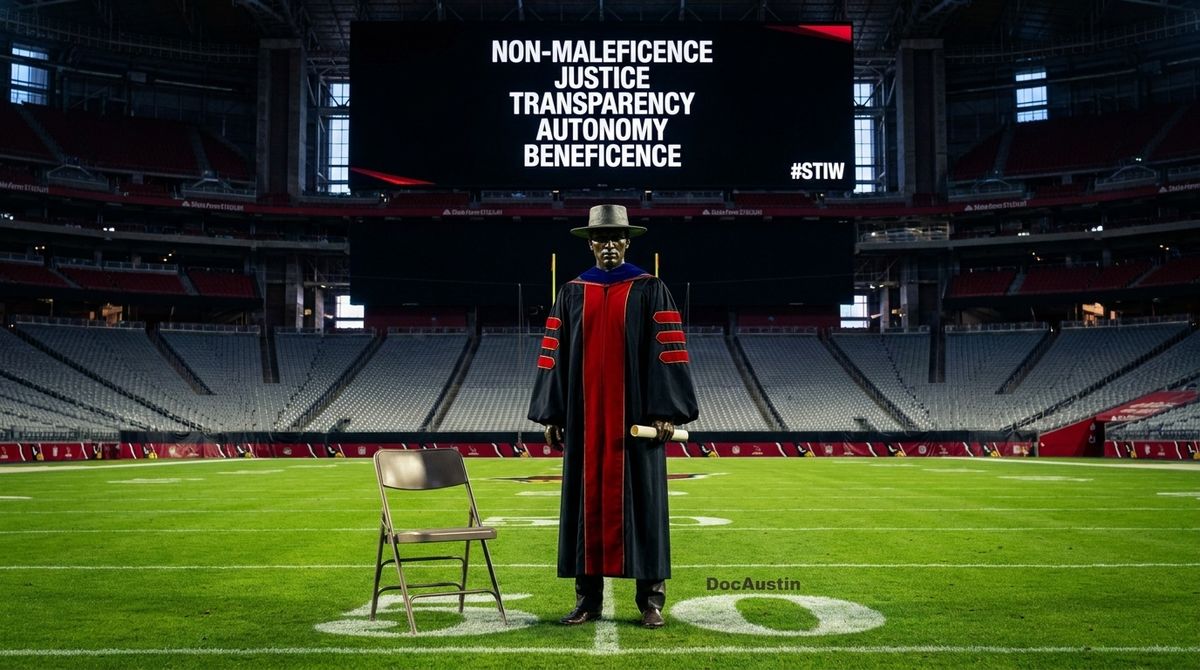
So, a little more detail on what my daily radar pulled up. A team led by an economist at the International Labour Organization ran what they considered one of the most comprehensive analyses of AI ethics frameworks to date. They fed 245 ethics documents, from governments, companies, universities, and advocacy groups, into natural language processing and large language models, and asked the machines to tell them what the world agrees on when it comes to governing AI. Two decades ago I did a smaller, narrower version of that by hand, one Fortune 50 ethics code at a time, highlighter and note cards, for four years. So yes, my first reaction was the obvious one. Dudes, a bot? Where were you in 2006?
And then I read what they found, and it brings back the same heavy sigh from 20 years ago. The machines discovered near-universal agreement on the principles. Roughly eighty percent of the documents pledge to do no harm (I guess we all read Asimov's Three Laws). Most sing about beneficence, transparency, justice, human autonomy. Broad international alignment around shared moral reference points, they call it. It is a beautiful consensus. And it is, in the authors' own words, too abstract to influence real-world outcomes. The guidelines name every virtue and fail to install even one mechanism to enforce any of them. Ethics as guidance, not ethics as governance. I sat there with a feeling I can only describe as an old bruise being pressed.
It's my dissertation. Not the topic, the finding. I went looking in those Fortune 50 codes and annual reports for the one thing that turns a principle into a decision, which is a named human being made responsible for arbitrating it, a leader accountable for the ethical culture and not just the ethics poster. I found a handful. Okay, three. Everyone had the values framed on the wall. Almost no one had put a person in the chair whose job was to defend them when it cost something. I wrote that down, defended it, got hooded for it on a 112° Arizona day, and flew back home to Austin.
And the very next year the American banking system fell down. Not for lack of ethics codes. Every one of those institutions had a gorgeous one. It fell under the weight of hundreds of ethical decisions that never took place, because naming a value is not the same as seating someone who will defend it the moment it becomes inconvenient, and there was no one in the chair at the mortgage companies, the banks creating the CDOs, or the ratings agencies. I did not predict a housing crisis. I documented an empty chair, and empty chairs have a way of getting filled by catastrophe.
So here we are, twenty years and a lot of artificial intelligence later, and the ILO is holding up the same X-ray. The same broad agreement on lofty words. The same missing foundation. Algorithmic management, worker surveillance, hiring by machine, all of it, in their phrasing, without a clear ethical anchor. The projector is faster now and the film is identical. We are about to run the 2008 experiment again, on a bigger stage, with the added twist that this time the decisions are being made by systems that cannot feel the weight of any of it.
Which brings me to the third thing I felt this morning, underneath the exasperation, and it surprised me. It was something close to joy. Because I did not just diagnose this two decades ago and move on. I went and built the answer to it, the thing that seats an accountable human back in the decision and hands them a way to actually arbitrate, and I have spent this whole second act of my life sharpening it for exactly this moment. The bot can count how many documents say justice. It cannot make anyone choose it. That part still requires a person. It always did. That is the good news hiding inside my aching bruise.
So here is my question this morning, from a guy who once spent four years proving that a values statement and a governed decision are in no way the same animal.
You have the principles. Everyone does. Eighty percent of the planet agrees on do no harm. But when the AI you deployed makes the call that harms someone, and it will, whose is the chair, and is anyone actually sitting in it?

#AI #AIGovernance #Ethics #Leadership #Accountability #TheEmptyChair #STIW