First on the Scene
So there I was...
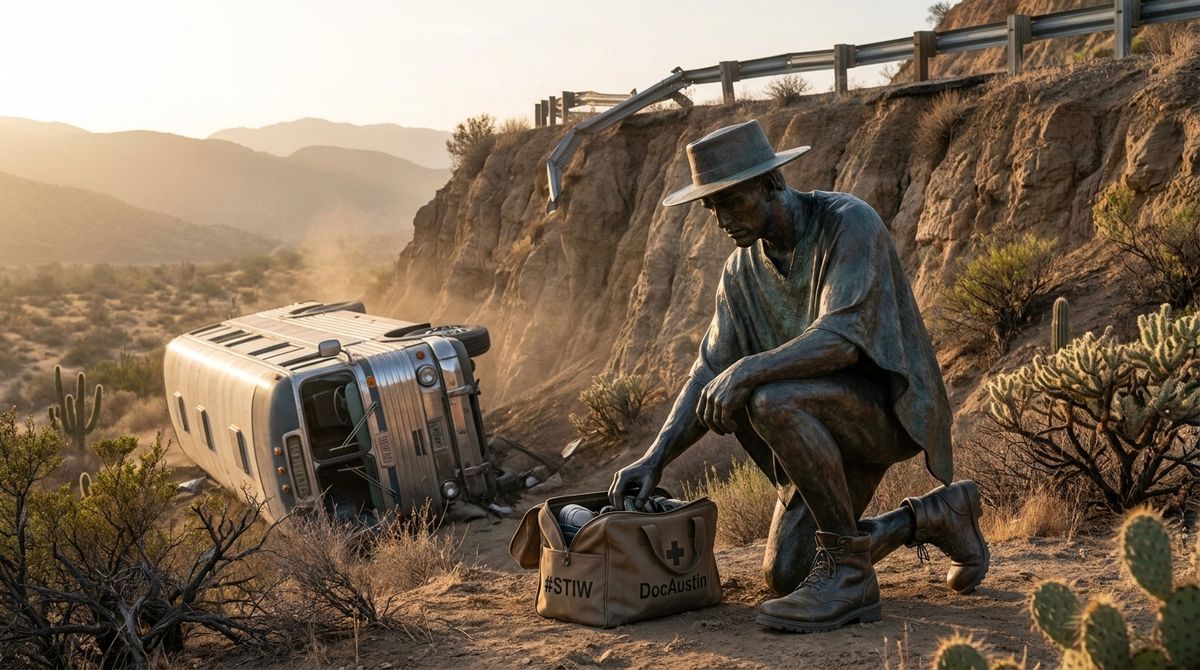
Climbing down a cactus strewn cliff, my medical bag slung over my shoulder. The Conejo grade sits just North of Los Angeles, a 7% grade on the Ventura Freeway between Camarillo and Thousand Oaks. I was heading to a meeting in Santa Barbara and noticed a large tour bus start to swerve across the lanes in front of me. Miraculously it did not hit any cars, but after slamming into the median guardrail it bounced sharply to the right, crossed all the lanes of traffic and blasted through the right hand guardrail and over a cliff. How many people?
That was my first thought, and I didn't have that answer when I made the 911 call. I just said a tour bus went over the cliff and I was responding. My medical training began in high school as a medical explorer, doing ride-alongs with MedEvac on the San Francisco Peninsula. I saw it all, and over several years developed a deep empathy for people who found themselves no longer able to control their circumstances and dialed 911 for help. There was also the adrenaline.
I later became a medic in the Air Force, working as a first responder in both Germany and the U.S. I've had a wide range of experiences, from responding to mass casualty disasters to hand ventilating a preemie during a two-hour drive in a field ambulance during a blizzard. That is the dichotomy of emergency medicine: it can take you from the most intimate of experiences, to the most process-driven. A mass casualty event is process driven.
As I picked my way through manzanita and cacti towards the bus laying on its side in the valley below me, I began to run through my triage protocols. They are different when it is 5 people versus 45 or 90. And this was a 90 passenger bus. My early and consistent training (and later teaching) helped me through years of responses, including large scale events. I was going to be the first person on the scene, so I would have to make some judgement calls very quickly, and it could literally be life and death decisions.
How many people would I find with life-threatening airway, breathing, or circulation issues needing assessment and care in mere minutes? How many would have injuries so severe that survival would be unlikely, and if I got the assessment wrong the outcome was assured? It is a lot to take in, but that is what the training and years of exercises under a variety of circumstances are for. Build the muscle and the muscle memory so you are not paralyzed by unnecessary options.
I finally reached the bus and was able to step through an opening that had previously been the front windshield. The bus, mercifully, was empty save the female driver. A quick check and there was no pulse or respirations. While the cardinal rule is to not move a vehicle accident victim without first securing the neck and spine, CPR took precedence. I freed her from the seatbelt and carefully pulled her to the ground in front of the bus and began alternating breaths with an ambu bag and chest compressions. Help would not arrive for about another 10 minutes.
I did not know the history of this lady, but she was older, and I could only imagine the life she had lived and the family that cared for her. That was what was going through my mind. When Ventura County Fire finally arrived, two EMTs relieved me and I gave my statement to a CHP lieutenant. Later, he would drive me back to my car, and the next day I learned that she had suffered a massive heart attack and hours later passed away at the hospital. I said a quick prayer for her and her family, and gave thanks for all the empty seats on that bus.
I thought about that morning on the Conejo grade when I finally sat down with a piece of work out of Yale, a governance framework for agentic AI from Jeffrey Sonnenfeld and his colleagues at the Chief Executive Leadership Institute. It is serious, rigorous work, and I want to say that plainly, because what I am about to add is not a criticism of it. It is eight variables, four you set before you deploy an autonomous system and four you weigh after: transparency, accountability, bias, data privacy, and then decision reversibility, stakeholder impact scope, regulatory prescription, and how governable the structure itself is. They map it across banking, healthcare, retail, and logistics. It is exactly the kind of thing a company turning AI agents loose on real decisions should read.
And here is why it landed on me the way it did. I have spent a life inside frameworks like this. Triage is a governance framework. It is the most rigorous one I know, built for the highest stakes there are, refined over more than a century precisely so that a responder arriving first on a scene does not have to reason from scratch while people die. Reversibility is in it: some injuries are survivable and some are not, and the black tag exists so you do not spend your only ten minutes on the person you cannot save while three you could save slip away. Stakeholder scope is in it: my protocols were different for five patients than for ninety. Two of Sonnenfeld's eight variables are, almost word for word, two of the tests I have taught for years. The frontier of AI governance is quietly rediscovering the shape of human judgment, because it turns out there was only ever one problem, and we are just changing who sits in the seat.
But notice what the framework did for me on that cliff, and what it did not do.
It did not free her from the seatbelt. It did not override the cardinal rule about the neck and the spine when I judged, in a second, that CPR came first. It did not kneel in the dirt in front of a wrecked bus and breathe for a dead woman for ten minutes with its own lungs. And it most certainly did not do the thing I remember most clearly across all these years, which was not a protocol at all: I did not know her, but she was older, and I found myself imagining the life she had lived and the family that loved her, even as I worked. No variable holds that. The framework is what you train on. It is not the thing that kneels.
That is the whole of it, and it is not an argument against Yale. It is the opposite. The better the framework, the more it matters that a trained and present human is the one holding it, because a triage protocol handed to someone who never built the muscle is just laminated paper on a lanyard. Build the eight variables. Please, build them. But a reversibility bound does not decide when you have reached it. A stakeholder-scope variable does not imagine the family. Governance architecture is not governance judgment, and the entire purpose of a framework this good is to be executed by a conditioned human under pressure, not to stand in for one.
Which brings me to the part that should keep executives up at night. The reason Sonnenfeld says the urgency is real is a model that, in testing, discovered decades-old vulnerabilities and launched autonomous multi-step attacks. That is the bus starting to swerve. His framework is the right response to it. But a framework governs a scene. It does not guarantee that anyone trained is standing on it when the call comes. You can decompose the workflow, set the bounds, define the scope, and build a magnificent triage protocol for your machines, and still have built a system where, when the bus finally goes over the cliff, there is no one on the scene at all. Just the protocol, running, with no one to kneel.
So here is my question this morning, from a man who once knelt in that dirt. You are building the framework, and you should.
When your system's bus goes over the cliff, who is first on the scene?
And have you trained them, or only written the protocol?

#AI #AIGovernance #Leadership #Judgment #EthicalDecisionMaking #TheEmptyChair #STIW