Nobody's No
So there I was...
Reviewing the n-hundreth application for a job I posted. I was super specific. You needed to live in the region, and you needed a specific number of years under your belt for various criteria. 90% of the applicants did not meet the basic criteria, let alone took the time to write a cover letter, tailor their resume to the job, or even proofread what they had submitted. It was chum, and I was the big fish (I guess?) that had to sort through the ick to get to the meaty stuff.
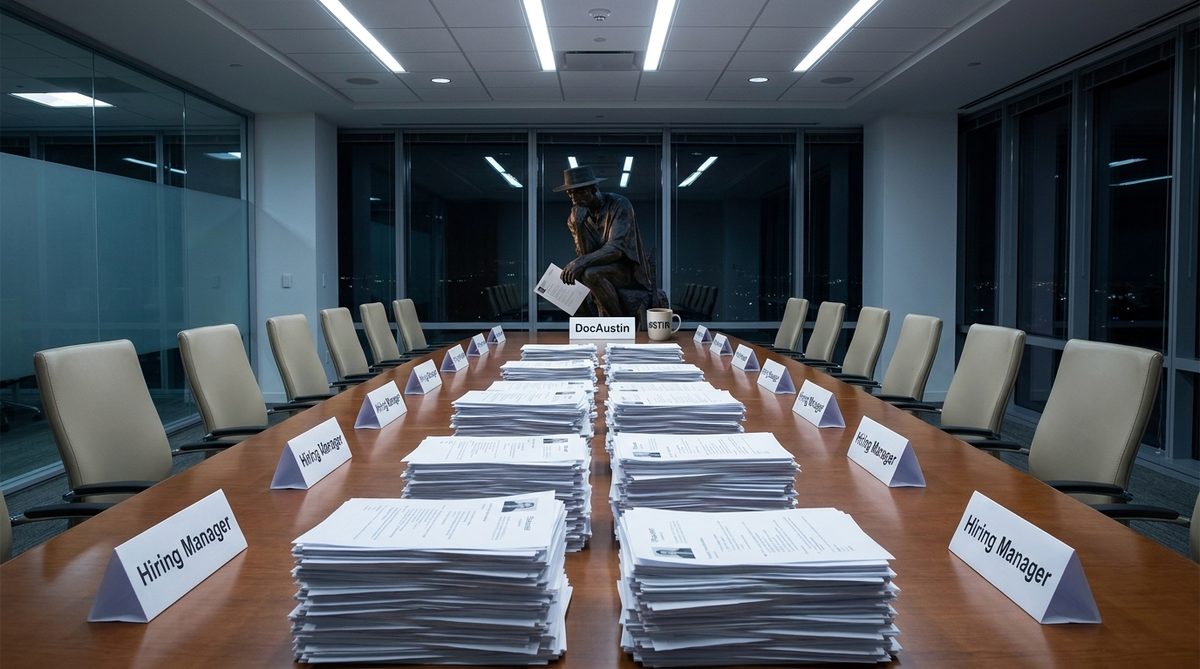
In 40 years of work I have hired easily 1000 people. Over 400 at one company alone. It is both exciting (you get to meet some really cool people, even if you can't hire them) and exhausting (hard to keep the same questions fresh). But I treated every interview as a unique experience, because I needed to get to the root of the person. I have certainly made some really bad hires over the years, but that comes with the territory. I've found that no matter how hard you try, the PTSD, bad mentoring, and corporate conditioning by prior employers can be incredibly hard to overcome, especially when dealing with high performing teams.
This brings me to a lawsuit in my old stomping ground of San Francisco that is currently being played out in U.S. District Judge Rita Lin's courtroom. This is a class action suit against Workday that was originally filed in 2023, for hiring discrimination violations as a result of AI screening software. I often talk about the empty chair, but you would not expect it to be the recruiter's.
Derek Mobley says he applied to more than 100 jobs since 2017 at companies running Workday's screening software, and the rejections came back instantly, sometimes overnight, at hours when no recruiter in America was awake. He is suing under the laws that protect age, race, and disability, and in May of last year the case became a collective action whose potential scope one commentator summarized as a billion rejected job applications. In June, Judge Lin ruled the California claims stand too, because Workday designed, built, and controlled those tools from its California offices. The case is now headed where discovery goes when the stakes are that size.
But set aside the legal theories, because the part that stops me cold is the defense. Workday's position is that its tools do not make hiring decisions, that customers retain full control. The customers, meanwhile, deployed the tool precisely so their recruiters would not have to read the chum I described above. So walk the chain with me. The applicant believes a company rejected him. The company believes the software screened him. The software company believes the customer decided. A man gets turned down at 1:50 in the morning by a decision that, according to every party involved, nobody made. My whole framework is built on one image, the chair that should hold the person affected by a decision, sitting empty in the room where the decision gets made. This case found a configuration I did not have on my bingo card: the decision room with all the chairs empty. No applicant, no recruiter, no owner. Just a process, humming along at machine speed, generating outcomes that are somehow everyone's product and no one's responsibility.
And here is what my forty years and thousand hires make me want to say about it. I understand the temptation completely. Ninety percent of what hits a job posting is noise, I said so myself three paragraphs ago, and a tool that clears the noise is worth real money. But there is a difference between a tool that sorts my stack and a tool that ends someone's candidacy while I sleep, and the difference is not technical. It is whether a person with a name stands behind the no. Every one of my thousand hires, and every one of the far larger number of my rejections, had my judgment attached to it, including the bad calls, and I own those too. That is what made the good calls mean something. A rejection nobody owns is not a decision. It is weather. And telling a job seeker their career prospects are weather is exactly the kind of thing courts eventually get asked to price.
The law will sort out who pays. That is Judge Lin's chair, and by all accounts she is sitting in it firmly. But for everyone deploying these tools between now and the verdict, the question is not whether screening software is legal. It is the question I would put to any executive whose company rejected ten thousand people last quarter.
Pick any one of them. Any one.
Can anybody in your building tell that person who decided?
And if the answer is no, whose chair is empty now?
Sources: Workday must face California lawsuit over AI bias in job screening tools, Reuters · Workday can't shake California AI discrimination claims, HR Dive · A federal judge, a 1967 law and a billion rejected job applications, Forbes

#AI #Hiring #AIBias #EmploymentLaw #Leadership #TheEmptyChair #STIW