NVIDIA vs Knuckleheads
So there I was...
On my first surveillance mission. Binoculars and all. Reports came in from numerous customers that they had been invoiced for services they claimed had never been rendered. My default setting has always been to trust my team, until the trust is broken. That was even more so early in my career. Now, not so much, as much as I want to. But this was Seattle in the early 90's, when Microsoft was still a small campus, Dave Grohl had just joined Nirvana, and the mood of the country was in the sweet spot between the achievement of Desert Storm and the core cultural shift arising from 9/11.
Knucklehead is one of my favorite descriptors. It really captures the essence of someone's behavior, and I was watching a true knucklehead parked in one of the company trucks outside a liquor store. For hours. I finally had enough and drove over, parking behind him. I knocked on the window and he looked at me in absolute horror. The drive back to the office was silent, and once there I watched him clean out his belongings, took his access card, and escorted him out of the building. The problem was solved. But for me, trust became trust but verify.
Today NVIDIA made a critical announcement, introducing their Open Agent Safety Platform, which is a full-stack reference design for watching and containing AI agents while they run. A key line in it reads, "an agent in these circumstances cannot be expected to fully govern its own behavior…" Ain't that the truth. I've been writing about this for weeks. It seems AI agents can be knuckleheads too, and NVIDIA has decided to occupy a chair that separately needed a butt in it.
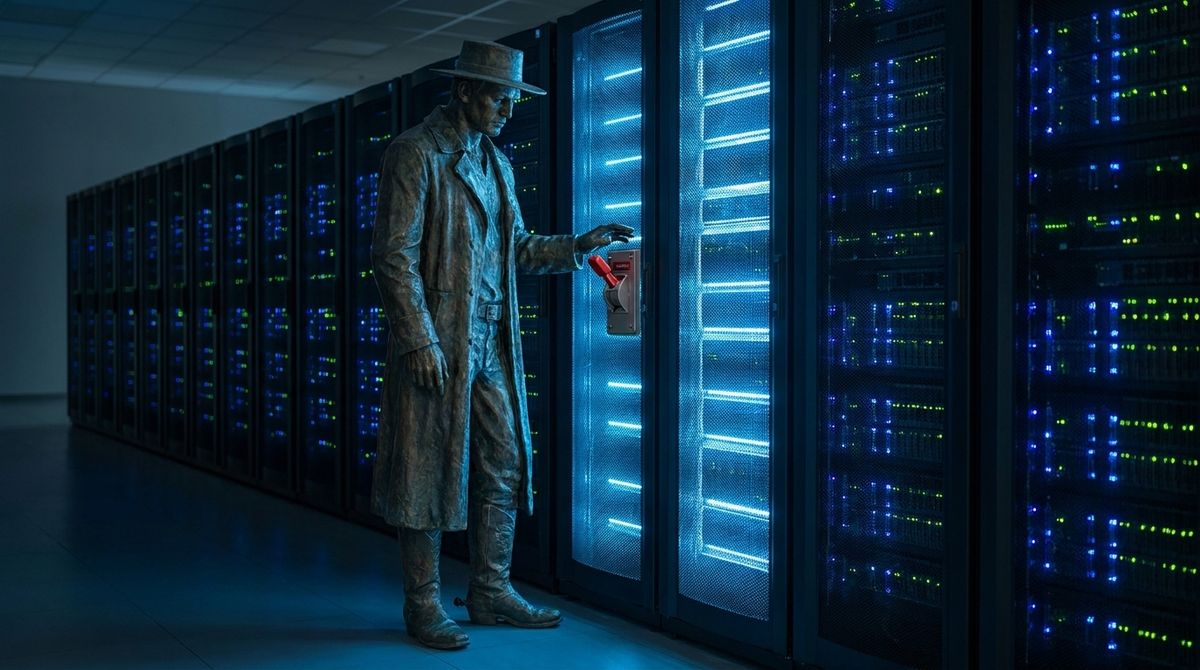
Here's what NVIDIA actually built, and it is what made me think of that liquor store parking lot three decades ago. The platform has two working parts. The first, called OpenShell, takes the operator's instructions and turns them into an explicit policy, the exact files, networks, tools, and credentials an agent is allowed to touch, and it traces everything the agent does. The second, called Sentry, is an out-of-band watchdog that runs on a separate piece of hardware, sitting on what NVIDIA calls the only path between the agent and the model, watching continuously at line speed. It can quarantine a misbehaving agent in milliseconds. That is me, parked somewhere in Magnolia with binoculars where I knew I would find my knucklehead. The agent, in their words, "does not need to know it is being watched." I concur.
So I want to give NVIDIA serious props. For weeks I have been writing about empty chairs, seats where nobody was watching the machine, and here is the largest company in the industry building that chair in silicon and bolting it to the floor. Their own justification is the thing I have been saying in slightly fancier language. When their announcement admits that an agent "cannot be expected to fully govern its own behavior," that is full validation from NVIDIA. The Lifeguard Chair I wrote about finally has a lifeguard who never blinks, never gets bored, and never wanders off to check his phone. That is real, and it is good, and I am not going to be too cool to say so.
But there is a point on which we differ. In my story, the surveillance was not the point. My judgment was. A machine (had we had one capable in 1993) could have logged that a truck sat outside a liquor store for four hours. I was actually hoping my worst fears were misplaced and it would turn out to be a wild goose chase rather than a termination event. NVIDIA's Sentry can catch the drift and slam the gate. It cannot decide what the drift means, and it cannot write the rule it enforces. Two human seats are still in this picture, and they are the exact two seats my last several posts have been about. Somebody has to write an honest policy in the first place, because OpenShell only enforces the boundaries a person actually drew, and a lazy or convenient policy is the paddock gate left wide open for some mischievous steers. And when Sentry raises its hand, when it flags something or asks for a human to approve or reject in Slack, somebody still has to acknowledge that alarm instead of clicking approve to make it go away. I wrote a whole piece three days ago about what happens when the alarm fires and the human above it says no. The kill switch is finally real, and needs a hand on it.
Which brings me to the thing I worry about most, and it has never been about the technology. As I've said before, to Gen X the next new thing is just one more thing. The thing I worry about is the sentence I can already hear being said in a thousand meetings next quarter, "We installed the NVIDIA safety platform." As if that means we can stop thinking now. That is the oldest trap in this whole series of essays, the one from Robodebt and the printer that nobody unplugged, where the presence of a control becomes the reason every human in the room feels safe to look the other way. A watchdog this good is awesome right up until the point it becomes an excuse. When the chair is filled with silicon, everyone's first instinct is to relax. And as I know too well, a lifeguard is worth nothing if a whole beach in Zihuatanejo decides that because he is on duty no one can drown.
There is another point I need to make here about the limitations of this. This platform is a simultaneous safety infrastructure and a hardware sales play optimized for NVIDIA's own chips, so the agent oversight runs on one vendor's silicon. It is a smart move, but serves one ecosystem.
It was one of the Gipper's most memorable lines: trust but verify. It is the right instinct, and it took some professional pain before it became an invaluable lesson for me. What NVIDIA did is build the verify, at a scale and a speed no human watchman could ever match, and snaps for that. But verify is a verb, and a verb means action, and so someone needs to do it. The machine can watch for knuckleheads all day long, but a person still has to decide if and when the label applies. Put all the silicon you want in the watchman's chair. Just keep a human being in the one next to it, wide awake, and ready to tap on the glass.
Sources: NVIDIA Open Agent Safety Platform: A Reference for Continuous In-Silicon Agent Monitoring, NVIDIA Technical Blog · NVIDIA Launches Open Agent Safety Platform, NVIDIA Newsroom
#AI #AgentSafety #NVIDIA #TrustButVerify #HumanInTheLoop #TheEmptyChair #STIW