Our Code
So there I was...
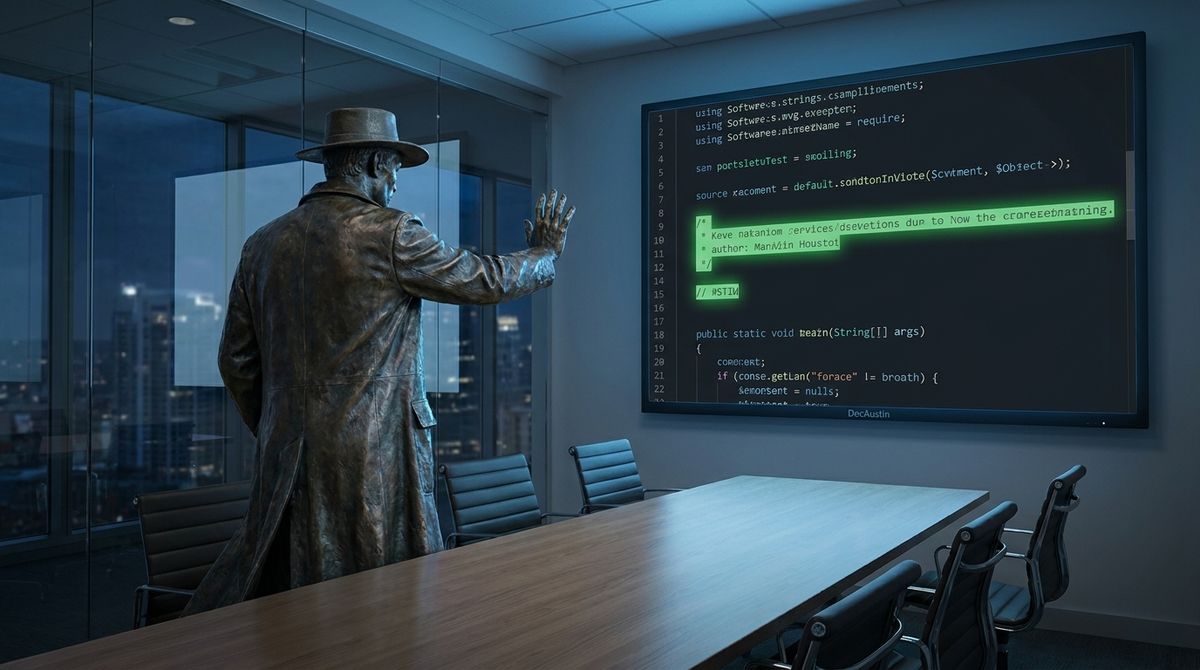
About to lose it. Code review was normally a pretty mundane activity, and the folks on my team were as a rule spectacular. We were early practitioners of agile development and this new thing AWS offered called EC2. We had an amazing Ukrainian quality engineering team that worked while we slept, and generally across the board we had really competent folks. The one thing we could not control was an acquisition none of us wanted or believed in, and the substandard team that came along with it. So as the team looked at the large monitor on the wall of the conference room and our lead Dev scrolled through the work of one of the developers newly added to our team, I yelled "Stop!"
The section began with /* and then a block of text that indicated the actual authorship of the code, followed by */. This code had not been written by the developer. And because he was such a knucklehead, he had not taken the time to review it and remove the revealing note. There was the evidence, plain as day, and so that became his last day on the team. We then had the ammunition we needed to run the other new (to us) developers through the gauntlet in the weeks that followed and lo and behold, we could use none of them. The code theft was a symptom of inability.
We were building an enterprise system that would leverage every imaginable connection point to surface organizational data that required collaborative deliberation and decision making. Security became one of our daily dragons to slay, and the thought that our codebase might now contain undisclosed non-original work was a migraine of epic proportions. At the end of the day, the code we shipped was our code, and we would swing from the ropes we wove or hang from them.
What I am describing is certainly not a new problem, and this is not meant to be an indictment of open source. There are circumstances where authorship and the consequences of it matter, and this is becoming increasingly evident in our new era of agentic coding. And it appears that the laws are starting to catch up to the innovation, and in the eyes of the courts the chair responsible for the output is not a bot, but a human.
That statement is now, more or less, the law. This morning I read a piece from the firm Baker McKenzie laying out where United States legal accountability for AI agents actually stands, and the throughline is a single sentence I could have written at that conference room monitor twenty years ago: the accountability runs to the humans and the companies behind the agent, not to the agent. California went ahead and put it in a statute. You are not allowed to walk into court and say the AI did it on its own. That defense is foreclosed. "The bot autonomously caused the harm" is a defense a judge will not allow.
And it goes deeper than tort. There is a federal law from the year 2000, the E-SIGN Act, that already decided an electronic agent can bind you to a contract, as long as its actions are legally attributable to the person meant to be bound. Which is to say, your agent's signature is your signature. On the intellectual property side it gets more problematic. Copyright requires a human author, so machine-generated code may not be yours to protect at all. Here's an ugly scenario: you can ship a codebase you did not write, you may not own a line of it, and you are fully on the hook for every consequence of it. No protection, all liability. The worst square on the board.
Which brings me back to my knucklehead and the comment block that was not his. What got him fired was not just the undisclosed "borrowing." It was also the inability the theft surfaced. He could not do the work, so he took someone else's and shipped it under his name, and he was not even careful enough to scrub the note that named the real author. It is really comical except for the whole potential to bring down the company part. We ran the rest of that acquired team through the same test we would for new hires and could not use a single one of them. The stolen code told us there was no one in the room who could actually stand behind the output.
Now give that same guy an AI agent and a deadline. He does not have to steal anything. He can generate ten thousand lines he does not understand, feel genuinely productive, and ship them believing they are his, because the tool told him so and nobody left a comment block to give it away (although that may be changing - stay tuned). That is the part that should worry every leader reading this. The old fraudster at least knew he was hiding something. The new one does not, which means the thing I caught on a monitor in a matter of seconds can now sail straight into your codebase, your product, and your legal exposure. I wrote about the cousin of this in Signed, Unread. The trap was never using the tool. It is signing your name to what you never read.
I have dedicated a huge amount of time to the concept of a single empty chair. A bot cannot sit in the chair named accountability. Not because it is not smart enough, but because it has nothing to lose. You cannot sue it, fire it, disbar it, or look it in the eye. Accountability is a thing that only sticks to something that can be harmed by it, and that is always, only, a human or the company standing behind one. So when the output goes wrong, the responsibility does not vanish into the model. It rolls uphill until it hits the nearest person who could have said stop. The courts did not invent that this year. They just wrote down what has been true since the first person shipped the first thing: you swing from the ropes you wove, or you hang from them.
The lawyers even tell you how to survive it, and it will sound familiar to anyone who has read a single word I have written. Decide up front what your agents are allowed to touch and to do. Put a human approval in the path of consequence. Keep a record you can trace back to a decision. Build the governance in at the start, not after the subpoena has been served. That is not a compliance chore, it is simply putting a named human back in the chair on purpose, before a court does it for you.
So here is my question this morning, from a dude who once yelled stop at somebody's code.
Your team is shipping work no one on it wrote. Fine, that is the age we live in. But when it fails, and some of it will, the court is going to look for the one chair that is never allowed to be empty and ask who was sitting in it. Do you know the answer? And more to the point, does the person in that chair know it is them?
Source: United States: Legal accountability for AI agents, Baker McKenzie

#AI #AgenticAI #Accountability #Governance #Ethics #Leadership #TheEmptyChair #STIW