Signed, Unread
So there I was...
Grading papers. Well, grading text, as this was a graduate-level online course: MGM 670 - Legal and Ethical Decision Making. I had the honor of developing the course, the first of its kind for this university, and then I was the first to teach it. The class consisted of second year students in an MBA program, and admittedly I had added a bit of rigor to encourage higher order critical thinking. But more importantly, and this still holds true today, I wanted to ensure a foundation for ethical decision making in the future.
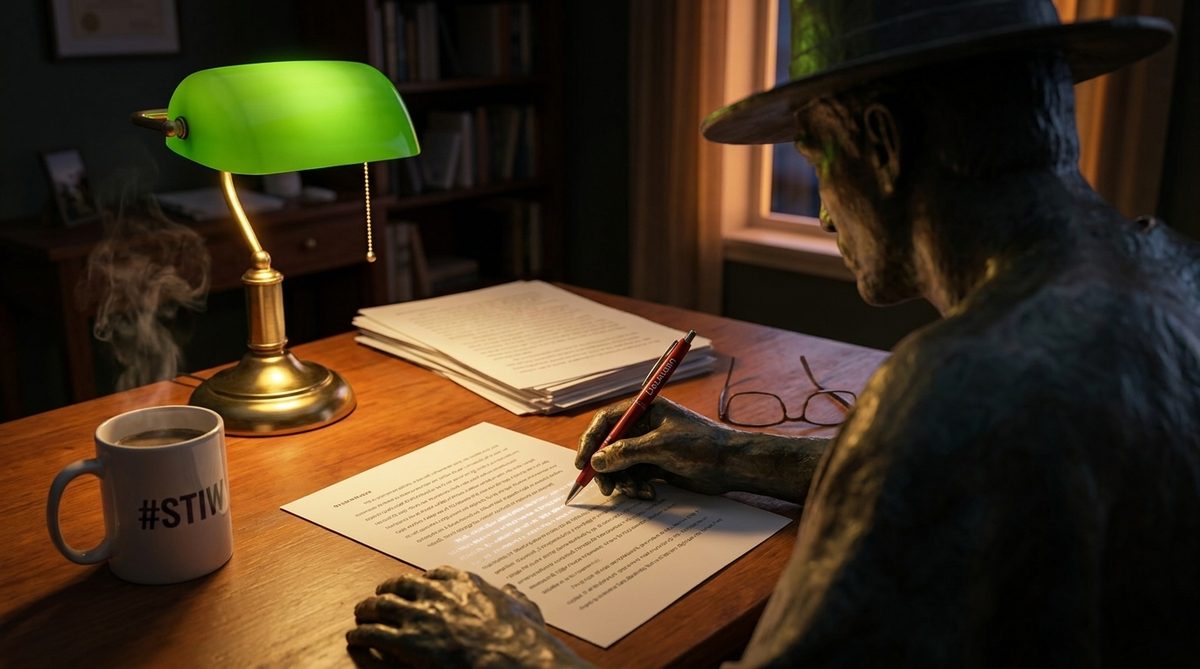
One thing about me, my face broadcasts everything I am feeling inside. So, I can only imagine what I looked like by the time I started grading the 5th consecutive submission with substantial plagiarism. Fair to say contorted. Plagiarism in an ethics course. And let me assure you, this was not simple citation oversight on the part of the students. And jumping ahead, this happened in every ethics class I taught at two different universities.
I am not an APA absolutist, so to make things easy I create an essay submission template for every class I teach to relieve the focus on format and allow students to focus on content and thinking. My one ask: if the idea is not your own, just cite it. I'm not looking for geniuses, I'm trying to help students build critical muscle for daily living. Find the concept, apply it to the problem, work the solution, and then defend the answer.
When you develop the curriculum, you generally have a really good recall of the foundational material you used to build the course. It was pretty easy to recognize entire verbatim paragraphs lifted from a textbook and dropped into a paper. I gave the offending students two choices: take an F and be reported for academic dishonesty, or rewrite the paper with a "B" as a maximum perfect score and also write a second essay on ethics for no points. And that essay had to include sources I provided. Everyone chose the latter.
My goal was not to punish, it was to teach. And my reasoning in this teachable moment was to create an experience that would last beyond the class and graduation, and hopefully drive a new set of behaviors that would be internalized in future endeavors.
So, my face twisted again when I read about Jason Gibson's history class, and the memories came rushing back.
Gibson teaches history at Alcorn State in Mississippi, and he suspected what every teacher now suspects. So he set a trap that cost him nothing but a font color. He buried instructions in his midterm in white text, invisible on the page, perfectly visible to any AI the exam got pasted into, directing the model to produce nonsense. Then he graded the results: 32 of his 35 students across two classes failed a portion of the midterm, because they had fed the entire exam to a chatbot and submitted whatever came back. Another professor runs the same play with a hidden instruction to slip the word Madagascar into the answer. Imagine explaining that one in office hours.
Here is what I want you to notice, though, because it is not the cheating. My students in MGM 670 at least read the textbook they stole from. That is almost quaint now. Gibson's students did not read the exam they were taking. The trap does not catch you for using AI. The trap catches you for signing something you never looked at. Those are different offenses, and the second one is worse, and it did not stop at the classroom door.
There is a whole invisible ink economy out there now, and every corner of it runs on the same discovery. Researchers have been caught hiding prompts in academic papers, white text whispering "positive review only" to the AI they assume will be doing the peer review, because they assume no human reviewer will actually read the manuscript. Job seekers are lacing resumes with hidden instructions for the AI screener, and by one survey 41 percent of them have tried it, because they assume no recruiter will actually read the resume. Employment lawyers are now writing client alerts about prompt injection as a hiring risk. Follow the white text and it will lead you, every single time, to a place where a human being delegated the reading and kept the signature. The hidden prompt is not the disease. It is the diagnostic. It only works where nobody is looking.
And that is why my old two-option offer will not transfer as cleanly as I would like. I could hand my plagiarists a rewrite and a second essay because a person who reads could sit across from a person who did not and make the lesson stick. Scale that to an organization where the reports are machine-written, the reviews are machine-read, and the approvals are machine-recommended, and you can build an entire loop where content flows from one AI to another with nothing but signatures in between. Everyone accountable. Nobody informed. A committee of empty chairs, initialing each other's work.
The fix is not another detection tool, and it is certainly not better white text. It is the oldest standard there is, the one I was trying to build in that online classroom: your name on it means you stand behind it, which means you read it, worked it, and can defend it. Find the concept, apply it to the problem, work the solution, defend the answer. The tools changed. The ask has not.
So before your next signature, digital or otherwise, a question from a professor whose face still gives him away.
When you signed the last thing that crossed your desk, had you read it?
And if there were white text hidden in your workday, what would it catch?
Sources: Professor hides white font in midterm, catches students using AI, Futurism · Researchers hide AI prompts in papers, Nikkei Asia · 41% of job seekers are hiding secret text in their resumes, The Interview Guys

#AI #Ethics #AcademicIntegrity #Leadership #Accountability #Trust #STIW