The Chair Made of Us
So there I was...
Reading a press release with my post-swim morning coffee. And everything I know to be wrong, and misguided, and have the potential for misuse was on full display. A lab in Singapore had switched on a server rack that runs on sixteen million living human neurons. Actual human brain cells, grown from stem cells and wired into silicon, humming away in a data center. I read it twice to be sure I had understood it correctly, and I had.
Cortical Labs, together with the data center developer DayOne and the Yong Loo Lin School of Medicine at the National University of Singapore, unveiled what they are billing as the world's first biological data center. Twenty units in a rack, each running on roughly eight hundred thousand lab-grown human neurons, connected to machines through electrodes so the signals travel both directions. This is the same lab whose earlier experiment taught a dish of neurons to play Pong. The pitch is that living cells can compute on just a tiny fraction of the electricity silicon requires, which matters a great deal as data center power demand is climbing through the roof. I live in Texas, and if you have been paying attention the data center issue has upended the politics on both sides of the aisle. The suggested uses are drug discovery, studying neurological disease, running humanoid robots, and catching fraud. Sure.
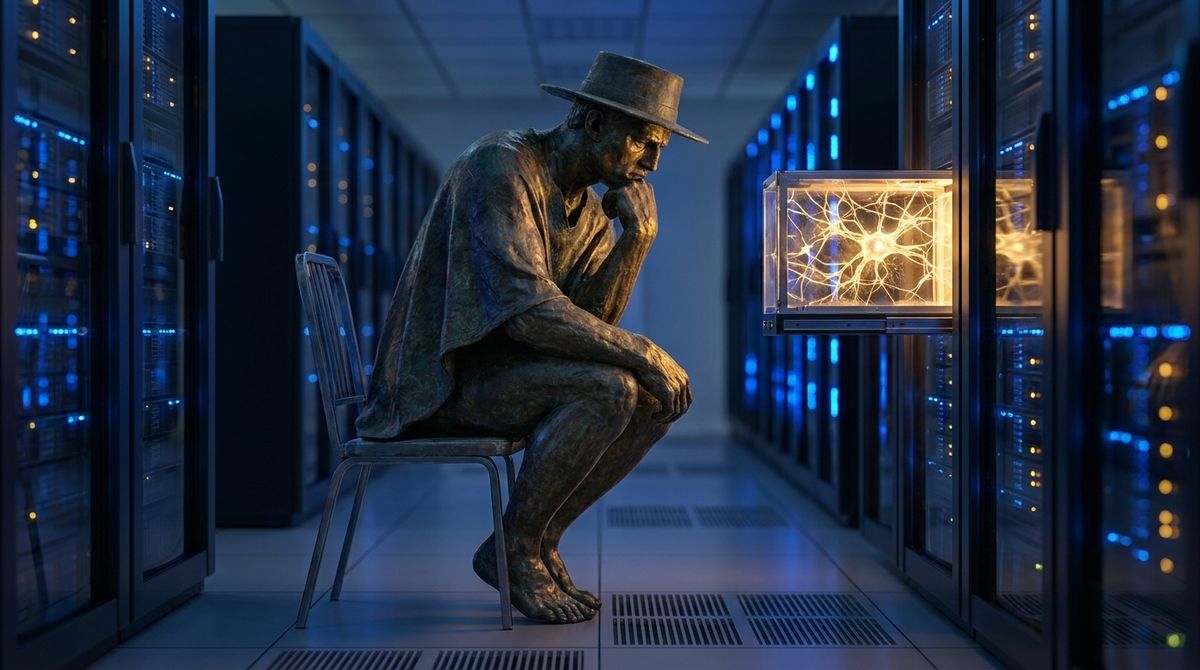
I want to be fair before I get to what has me riled up, because the argument for the potential is legitimate. If you can understand how a neuron learns by watching actual neurons learn, you can chase cures for diseases that have stymied us for decades. Doing it on a fraction of the energy also solves one of the more cogent arguments against modern computing. Those are worthy goals, and the people doing this work are serious scientists solving a real problem from a unique angle.
But I read the official announcement top to bottom looking for a single sentence about the ethics of building a thinking machine out of human tissue. Who is watching this? What lines will not be crossed? What do we do if the thing in the rack turns out to be more than a component part? There was not a single mention of ethics. A first-of-its-kind, independently operated system made of human brain cells, and the chair where the ethicist should be sitting was not only empty, but based on the report completely missing.
For months I have been writing about humans stepping out of the chair and decisions being handed off to AI as the person who should own it wanders off. What is happening in Singapore is stranger and far more troubling because someone has started doing the reverse. They are putting the human into the machine in pieces, the actual gray matter, and building it for a purpose biology never intended. The question I always ask is whether a person is still in the loop. The question now is whether the machine has quietly become part person, and whether anyone has been assigned to watch that line as it is crossed. Rhetorical question.
There are three questions a competent ethicist would be asking out loud right now as they scale this past twenty units. The first is one I don't think anyone can answer, but it needs to be asked just the same. At what point does a growing, learning mass of human neurons begin to have something like an experience, and how on earth would we know? We have no test for it. Cortical's own language is that these cultures learn and adapt. If a cluster of human brain cells can learn, then someone needs to be in the chair whose whole job is to ask whether there is the faint beginning of a someone in there, and to ask it before we are selling that someone's compute by the rack. Or worse yet, dispose of what was made obsolete by an improved upon version.
The second question is older, and we already know how badly we have historically handled it. These neurons are grown from human stem cells, which means they come from a human being. Whose cells, consented to for what, and who takes the profit from a thinking product built out of a person's living tissue? We have walked this road before with Henrietta Lacks, whose cells were taken without her knowledge and have been bought and sold for seventy years while her family remained unaware. Now picture that same story where the tissue does not merely grow in a dish but computes, and maybe learns. The consent form we have yet to write is going to look very thin, very fast.
The third question is this blog's raison d'être. The technology is here, running, in production, and the framework to govern it is nowhere to be found. That is the Robodebt lesson and the killer-drone lesson reappearing for a third time in successive posts. The tool ships first and the ethics are promised to be addressed later, and later has a habit of never arriving until the harm is already done. Once again, a commission will be convened to discover what we all knew at the start.
My mind goes somewhere a bit more dangerous, because my experience has been shaped by an innocence that came before a war and a far different perspective that followed it. Once a substrate exists that is made of us and can learn, the pull toward the worst possible uses is not paranoia, it is momentum. The money and the power in a technology like this gather wherever the stakes are highest and the oversight is weakest (cough, cough, crypto), and that means the potential military uses, the policing uses, the private-prison uses. Picture a model trained to predict one specific person's behavior, running on tissue derived from human brains, sold to whoever wants to watch, sort, or contain people at scale. And is it unreasonable that a human being could become the rack? We are nowhere close to that today. What NUS switched on is much nearer to a dish playing Pong than to anything sinister. But the road from here to there simply has no guardrail on it, the guardrail being the decision chair that has not even been dragged into the room.
So here is my question today, from a guy who continuously fights for our better angels after experiencing their absence.
We have built a computer out of our own brain cells, and the chair for the person whose job is to ask whether we should appears to be missing. Every hard thing this technology could turn into runs straight through that unfilled seat. Before it goes from twenty units to twenty thousand, someone has to pull it up to the table, sit down in it, and own it. The only question that matters is who, and whether they get there before the thing in the rack becomes something we owe an answer to.
Sources: Singapore Deploys a Biological Computing Rack, TechRepublic · NUS Medicine, DayOne and Cortical Labs Unveil Biological Data Center Prototype in Singapore, NUS Medicine

#AI #Ethics #Bioethics #Neurotech #Biocomputing #Accountability #TheEmptyChair #STIW