The Chair That Heals. The Chair That Kills.
So there I was...
Laughing at a highlight reel of robots falling miserably. It could have been a Monty Python sketch set to a Benny Hill soundtrack. If you have not seen the footage from this year's robot games in China, treat yourself. Machines built specifically to run, kick a ball, lift a weight, run 100 meters, and more often than not ending up on the floor in pieces, or even more enjoyably in uncontrollable spasms or on fire. It is really good stuff. Dozens of examples of expensive engineering unable to replicate the feats of human strength and speed they were designed for.
I watched a lot of it, trapped by the spectacle and because it is genuinely hysterical. But that was Wednesday, and then there is what I read yesterday, and then what I read this morning.
Recently I had the good fortune to meet Dr. Sivan Tamir, Head of Bioethics and Genetic Policy Unit at KSM Research and Innovation Center in Tel Aviv. Dr. Tamir is a well-published expert in medical law and bioethics, genethics, genetic policy, big data ethics, AI ethics, clinical research ethics, and reproductive ethics. In other words, my kind of people. She shared with me a scientific paper she wrote titled Ethical governance of AI-based humanoid carebots: the case for Ethics of Techno-care. AI-based humanoid carebots (AIhCs), or, more simply, robots designed to care for humans.
I dove into her paper yesterday where she identifies the need for techno-care-specific ethical governance, and the insufficiency of existing ethical frameworks to govern this emerging technology. She proposes an approach that considers "human care-sensitive design, minimally-necessary deception, techno-care transparency, techno-care privacy design, techno-care autonomy, techno-care responsibility and accountability, and diversity and cultural sensitivity in AIhC design."
Dr. Tamir published this paper over a year ago, and so I feel late to the party getting to it just now. Just the topic of the anthropomorphisation of AIhC's and their potential impact on vulnerable populations (e.g. neurodivergence, diminished capacity, mental illness, etc.) gives me pause. While there are so many benefits, especially considering aging populations outpacing their ability to be properly cared for, how do we reconcile their inherent deception with a care-recipients' autonomy? Please read the paper (linked below). It is really good.
And then there is what I read this morning after nearby lightning strikes ruined my swim. People have been arguing for some time about whether AI-guided machines should be allowed to decide to kill a human being. The Russian military has decided Skynet is ok. Unlike what we have seen (so far) with the Ukrainians use of AI, when a primary military target is unavailable, a secondary civilian target is identified by the AI and it goes for the kill. This was discovered by examining a chip from a recovered Russian drone.
Should we prevent a weapon from finding its own target and pulling its own trigger? Should a human be in the loop in order to call an action controlled? Does a person have to authorize each shot? Do you have to do more than simply switch a system on and walk away? Apparently the Russians are saying nyet.
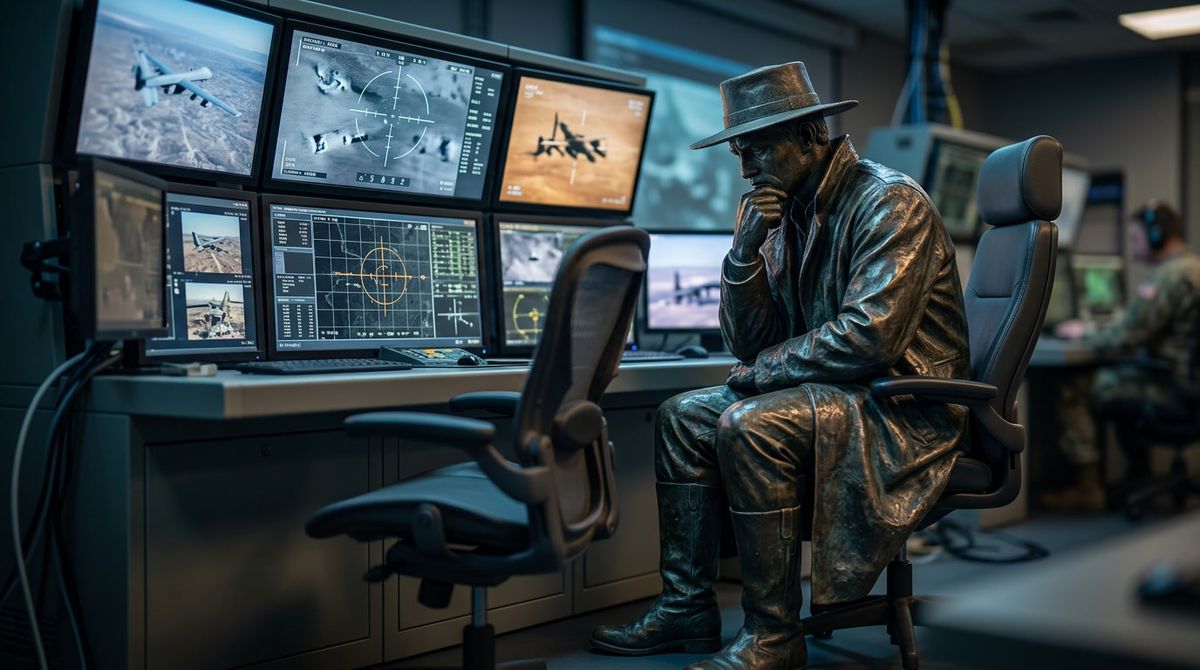
They have settled the argument over how empty they are willing to let the chair get when the output is a dead human being. So now I'm trying to reconcile AIhC's and killer drones.
Meaningful human control is the empty chair question, in one case wearing a lab coat and in another wearing body armor. It is the exact same problem I have raised repeatedly in my posts, except here the wrong answer is not a good or bad balance sheet, it is the irreversible impact on a human life. The fact that there is a debate on the highest-stakes decision an autonomous machine could ever make, to take a life, and whether a person is even required to be in the seat is a moral catastrophe. How a machine might care for the most vulnerable of us is the question of our time.
Dr. Tamir, in considering the ability of an artificial agent to operate independently and without direct human intervention/instruction in the care of human beings, stated "robo-ethics frameworks are simply not entirely adequate or sufficient, for AIhCs." She's exactly right. The ethics of care (EoC) framework never anticipated robots, and so a new approach is required, one drawn from a myriad of philosophies to provide the necessary normative guidance. She identified 7: human care-sensitive design, minimally-necessary deception, transparency, privacy, autonomy vis a vis informed consent, responsibility and accountability, and diversity and cultural sensitivity in design.
In the Russian Skynet dystopia, an AI has been taught to kill. The wheat fields of Ukraine have become a proving ground for it on both sides, with decidedly different approaches, but the same underlying moral, ethical, and legal conflicts. A field general means one thing, a manufacturer means another, and the engineer who wants the system to act faster than a human can think means a third. And there is a version of a human in the loop that is worse than no human at all, the person who exists only to press a green button for whatever a machine surfaces. That is not control, that is just a human being used as legal cover for a decision that was a fait accompli. Machine decision, human rubber stamp, let's call it oversight and go for beers.
It should not matter if it is the battlefield or care facility, you cannot leave the chair empty when the output is an irreversible act on a human. In three consecutive days I watched robots on a highlight reel that could not make it down the track without an epic faceplant. I read an incredible scientific paper that is lightyears ahead of the curve on the ethics of how robots may eventually care for human beings. And today, a nation handing machines the single hardest moral decision a human ever faces, whether another person lives or dies. We cannot get robots to reliably kick a ball, yet we debate the rules for letting them execute a human. The ethical gap between what these machines can actually do and what we are allowing them to decide cannot be overstated.
So here is my question today, from a guy who spent one morning laughing at robots falling down, the next morning considering the infinite complexity of ethics for AIhC's, and then the grimmest of AI ethical dilemmas as the thunder faded into the distance this morning.
What are we doing? AI is capable of solving so many of the world's challenges, but it should not occupy a chair that is meant for a human. And when we do allow it, what does that say about our ethical compass?
Sources: The three words that will decide whether robots can kill people in war, Vox · Ukraine Recovers AI Chip From Russian Drone, The New York Times · Ethical governance of AI-based humanoid carebots: the case for Ethics of Techno-care, Sivan Tamir, Medicine, Health Care and Philosophy (2025)

#AI #Ethics #Carebots #AutonomousWeapons #Bioethics #Accountability #TheEmptyChair #STIW