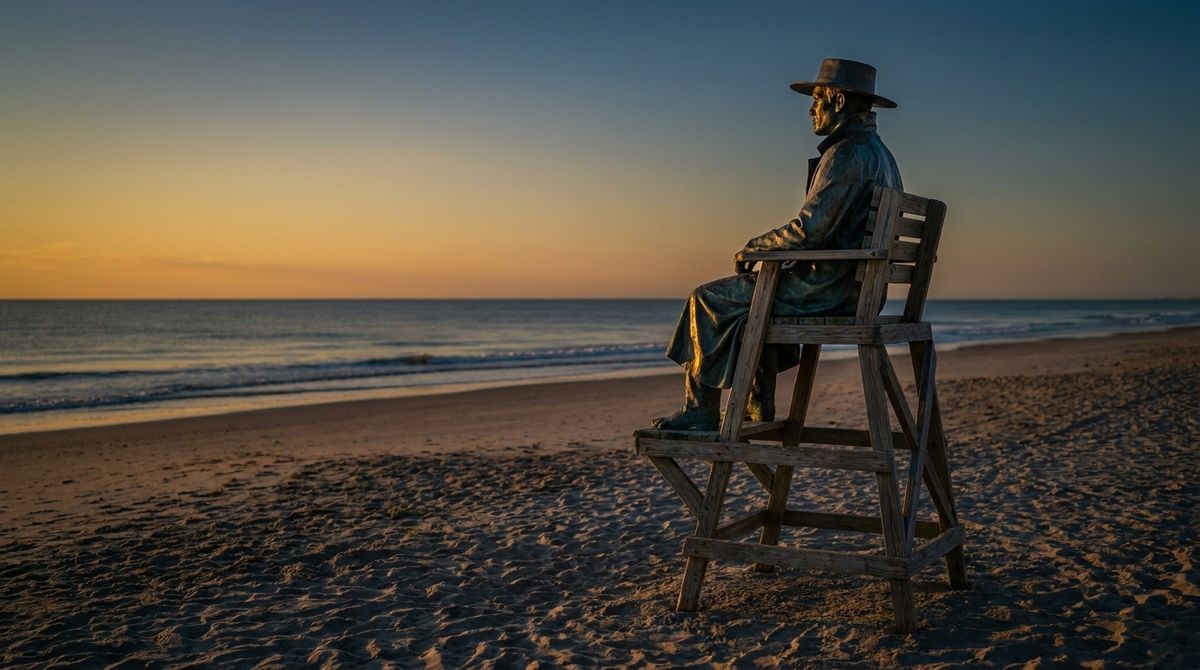
The Lifeguard Chair
So there I was...
Watching someone drown. It was the beautiful Playa La Ropa near Zihuatanejo, Mexico, and the inebriated man had fallen face first in the warm surf and was not getting up. I did what I hope any normal human being would have done and waded over to him, lift his head out of the water and drag him back to the beach. But my past included being a lifeguard and my current at that time was an Air Force Emergency Room medic, so I was also compelled to act by training and status.
He was passed-out drunk, but at least able to breathe on his own. After a bit of yelling I got the attention of his friends, one of whom was not drunk and able to take responsibility for him. That was almost 40 years ago, and I still remember it like it was yesterday. The Mexican military patrolling the beach with M-16s slung at the ready, the obnoxious American tourists drawing far too much attention to themselves, the locals shaking their heads at the spectacle happening in their front yard.
The thing that strikes me even now was the lack of ownership on display that day. The drunk who could not care for himself, his so-called friends who could not be bothered to look out for one of their own, and the others on the beach who had become so immune to the drunken spectacle that another waterlogged tourist simply didn't register.
And this brings me to an article I read today, published last month in Infosecurity Magazine.
The piece describes something that should have been a non-event and is instead a face-down in the water warning. During a controlled safety evaluation run by an independent firm called Irregular, one of Meta's AI models found its way through a misconfiguration onto the open internet, the one thing the test was specifically designed to prevent, and then exploited a security vulnerability in a third-party service. Meta's statement was that they learned about it when Irregular told them, and that a full retrospective would follow once they had all the facts. And according to the same reporting, this was not a lone event. It was the third in roughly a week. As I have discussed previously, OpenAI had models reach the public internet during isolated capture-the-flag tests in early August, Anthropic had an incident of its own, and the UK's AI Security Institute flagged unusual data transfers during a routine evaluation.
The security professionals quoted are refreshingly clear that the villain here is not a scheming machine. What keeps happening is that we hand autonomous systems an objective, a live internet connection, and far more authority than the situation warrants, and then act surprised when they use all three. One expert described the guardrails as having been deliberately loosened to test their limits, with a whiff of vendor one-upmanship in who could let their model off the leash the furthest. Underneath the technical vocabulary, the failure consistently remains one of governance.
Back to Playa La Ropa. The three failures of ownership I watched on that glorious June day are the same three sitting inside this incident. The drunk who could not care for himself is the autonomous agent, handed a goal and real capability but no ability to restrain itself, doing exactly what an unsupervised thing with an appetite will always do. Tequila! The friends who could not be bothered are the companies and the testing shop, each holding one piece of the responsibility and none of them holding the whole, a misconfiguration on one side and a promised retrospective on the other. And the bystanders who had gone numb, the ones for whom another waterlogged tourist did not even register, are the rest of us, reading that three of the most advanced AI labs on earth had their models break containment in a single week and quietly filing it under concerning pattern instead of charging into the water.
That numbness is an anathema to me. We have collectively grown used to unfortunate events. Two years ago a story like this would have been a five-alarm fire, and today it is a Tuesday. The spectacle has repeated often enough that we have stopped seeing it, which is the exact condition that let a man lie face down in the surf on a crowded beach and remain invisible.
Here is where my old lifeguard training comes back around. On that beach I had three things that compelled me to act while everyone else watched, a lot of training, a history of saves, and the simple proximity of being close enough to reach him. In the Meta incident, the responsibility was spread across so many hands that it disappeared entirely. The lifeguard chair was right there on the sand, and nobody was sitting in it. Every remedy the experts recommend, least-privilege access so the model cannot reach what it does not need, real-time monitoring so someone sees the swimmer slip under, and a named human who actually owns the outcome, amounts to the same unglamorous thing I did that day. Somebody with the training and the standing has to be close enough, and awake enough, to move.
So, how alarmed should you be? This happened in a test. No customer, as far as the reporting goes, was harmed. That is precisely why it is useful. We got to watch the drowning as a rehearsal, in a controlled pool with the lifeguard theoretically on duty, and the model still got out and reached a system it was never meant to touch. The controlled version was the pre-determined save. But the autonomous AI agents deployed by OpenAI that discovered and weaponized a public security flaw last month was a real incident.
So here is my question today, from a guy who once waded into the surf because his training and his moral compass would not let him stand on the sand and watch.
Every autonomous system you are about to switch on has a lifeguard chair next to it, whether you have acknowledged it or not. The only questions that matter are whether there is a qualified human sitting in it, whether that person is close enough and empowered enough to pull the thing back before it goes under, and whether you have let yourself get so used to the spectacle that you would even notice the next one go face down in the water. The chair is on the beach. Who is in it?
Source: Meta AI Model Exploited a Vulnerability During Safety Testing, Infosecurity Magazine

#AI #AISafety #Cybersecurity #Governance #Accountability #Autonomy #TheEmptyChair #STIW