The Spot on the Beach
So there I was...
North Shore, Oahu, December 10, 1987. A week earlier my buddy and I hopped on an Air Force C-5 at Rhein Main, Germany, and made our way to Travis AFB outside of Sacramento and then on to Hickam AFB in Honolulu. We checked in at the AFRC hotel, Hale Koa, on Waikiki Beach, grateful for the incredibly affordable room rate that was based on our lowly rank as Airmen 1st Class. We immediately did the usual idiotic stuff guys do in a tropical environment with an amazing beach and cheap drinks. But the big waves outside of Haleʻiwa Town were top of our list.
We both grew up in California, but not in beach communities. I spent much of my teenage years driving 5 hours south to spend weekends windsurfing off the State Street Pier in Santa Barbara, but my pal had been hopelessly landlocked in West Covina. I had been to Hawaii numerous times throughout my childhood and teenage years, and had done a bit of longboard surfing with the other tourists, but nothing more than some knee slappers.
This time around we both had ambitions far in excess of capabilities or experience when it came to big waves. And it is amazing how surfboard shops don't want to rent to a couple of idiots, so we found ourselves boardless and dying for some gnarly waves. Now, it is important to point out that in your early 20's, frontal cortex development is not yet sufficient to properly regulate impulse control, risk evaluation, and long-term planning... Body surfing!
So, we ran out into the surf only to be mercilessly pounded into the sand a few moments later. I definitely had the wind knocked out of me, and regained my breath to the sounds of cheers. A crowd of actual surfers had formed a semi-circle and thanked us for the wonderful entertainment. I love the scene in Surf's Up where Zeke marks the exact spot on the beach where Cody will wash ashore following his wipe out. That was us two decades before.
It is clearly a scene that has played out thousands of times on beaches all over the world, and those that have dedicated their endless summers to the waves can spot the sunburned sacrifices to the ocean gods the minute they exit their rented Jeeps.
That was the flashback I had this morning as I read UNESCO and the Thomson Reuters Foundation's global report "Responsible AI in practice." I know exactly the spot on the beach where this lands. I just wrote a book about it.
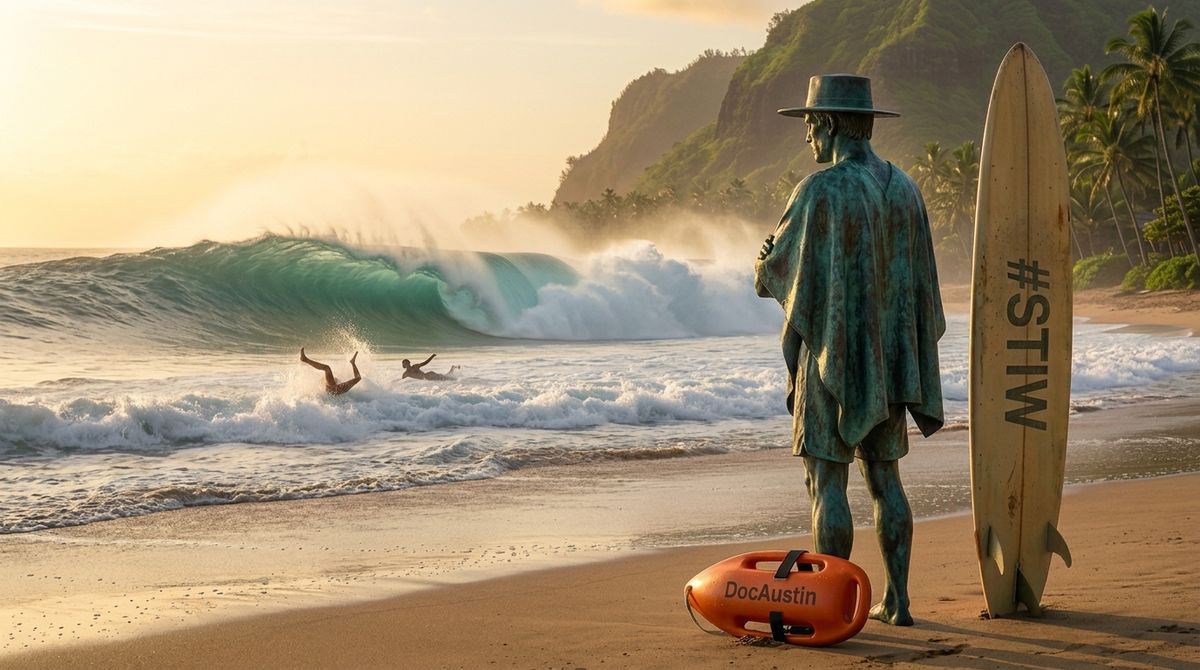
The report is built by looking at what three thousand companies actually do with AI, not what they say about it. Reading the numbers, I was right back on the sand at Haleʻiwa, watching two guys in board shorts sprint into water they had no business being in.
Start with the ambition. Forty-four percent of these companies have an AI strategy. Which means more than half do not, and every one of them is already in the water. Then comes the capability, and that is where the wave meets the sand. Only twelve percent have a policy that keeps a human in the loop on what the AI decides. Seventy-five percent never check the quality of the data they trained on. Fewer than one in five ran a privacy assessment before deploying. Seven percent looked at the human rights implications. And the one that stopped me cold, because it is the whole point of everything I do: one in six companies cannot name who is responsible when their AI causes ethical harm. Cannot name them. The chair is there. It is just empty.
That is a couple of Airmen First Class running into the surf off Haleʻiwa. Ambition far in excess of capability or experience. And just like the real surfers who formed that semi-circle to watch us get flattened, there is a whole community of people who have spent their endless summers on this exact water, and we can spot the sunburned sacrifice the second the Jeep door opens.
Here is what the beach taught me that the boardroom keeps having to relearn. Wanting the wave is not the same as being able to ride it. The report's own authors land on the same rock: the problem is no longer awareness, everyone is aware, the problem is operationalizing. That is a ten dollar word for the thing every waterman knows in his body, that the only knowledge which saves you is the knowledge you have drilled until it lives below thought. Forty-four percent wrote "strategy" on a sheet of paper. Twelve percent actually built the muscle to hold the line. The rest ran into the shorebreak.
And notice which checks the companies skipped, because it is not random. Data quality. Privacy. Human rights. Environmental impact. Every neglected safeguard on that list protects someone who is not in the room when the AI ships, the person downstream who will live with the decision and had no say in it. That is not a technology gap. It is the oldest gap there is, and I wrote a whole book about the chair we keep leaving empty for them.
So here is my question this morning, from a guy who once got pounded into the sand off Haleʻiwa while a crowd cheered. The wave is here. Everybody is paddling out.
Have you built the capability to ride it, or have you only written "strategy" in the sand?
And when the AI wipes out and someone washes ashore, whose is the chair that should not have been empty?

#AI #ResponsibleAI #AIGovernance #Ethics #Accountability #TheEmptyChair #STIW