Venecky
So there I was...
In a fight for my very survival. The thing about a 50cc syringe is that if you put a 12g IV catheter on the end of it, the liquid inside can shoot a good 20ft with enough heavy pressure on the plunger. And so as I rounded the corner I took aim at the clinical rotation student darting out of the supply room and nailed the left side of his head. He let out a satisfying whelp and I gave him another shot in the back of the neck as he ran from me. Welcome to 1:00am in an empty ambulance bay.
Earlier that day an electrician had come to complete a work order to ensure that we had more outlets connected to the emergency generator circuit. For important stuff, like IV pumps, EKGs, defibrillators... you know, the stuff you need in an ER to save lives. My 12-hour shift didn't start 'til 19:00, so I missed the part where he somehow mis-wired the standard 110v circuits and the 480v emergency generator system and poof! Everything in the ER that was plugged into the wall was destroyed. All our equipment, even the ballast in the fluorescent lights, fried.
The hospital commander declared an emergency, civilian paramedics now covered the base, and we were no longer receiving patients. Our ER was officially closed for the very first time. By the time I arrived for my shift, contractors were already swarming the ER, removing all of our destroyed equipment, pulling melted wire from conduits, checking for anything that might be smoldering. The irony is that this upgrade was meant to ensure our most critical equipment would stay powered up during a blackout and that equipment is exactly what got destroyed.
We moved the ambulances outside since the garage doors no longer worked, and found ourselves with nothing to do except work on training, and so the empty bays became our makeshift classroom. As a Phase II preceptor, it was my job to educate Air Force medics on the workings of the ER during the clinical phase of their training. I loved being an instructor since there was always a way to deliver a lesson to make it memorable. So, that night's lesson was about IV catheters, why we had different gauges, and the checklists we followed to start any kind of an IV. So naturally I turned infusion rate into a water fight.
Fast forward 40 years, and a group of middle school students, their teachers, administrators, and parents got a lesson they will not soon forget. We check things for a reason. It doesn't matter if it is the gauge of a catheter or the gauge of a wire, we check to make sure we are doing the right thing with the right tools. That is a chair that cannot be empty, even for a moment.
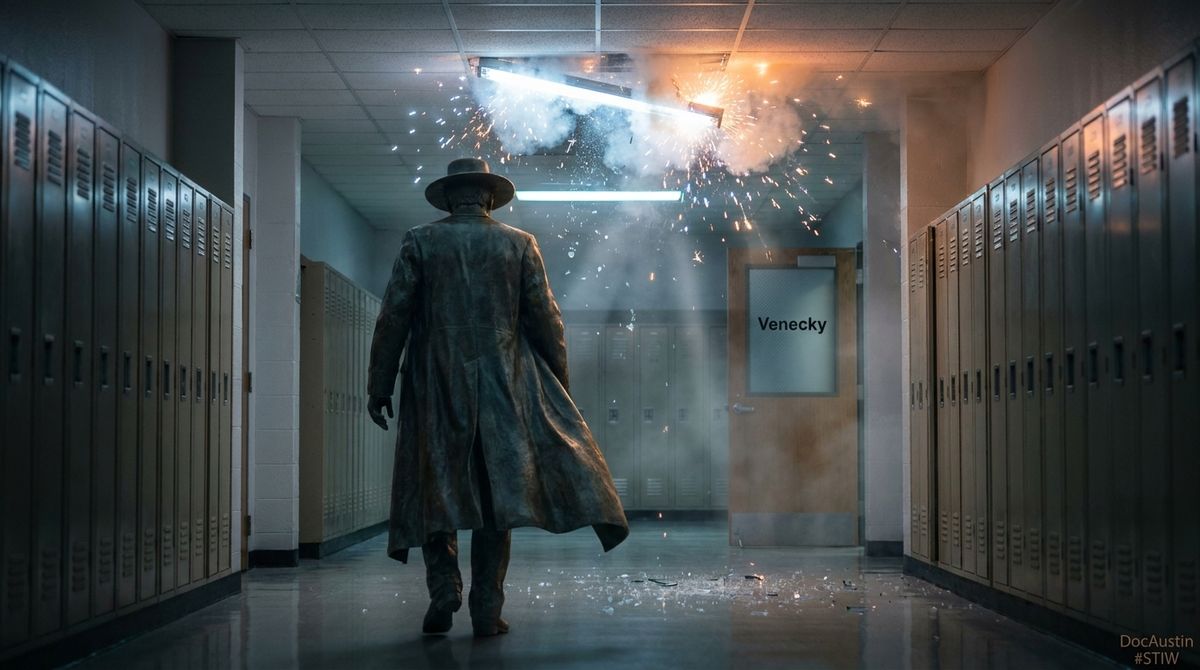
Here is what happened. Farnsley Middle School in Louisville handed out student agendas on the first day of school, the planner every kid carries all year, but it was riddled with errors that anyone would have caught had they simply glanced at the pages. There was a map of the United States with the state names run through a blender. Kentucky came out "Venecky." There was a "North Dahota" and an "Olkchoma." Louisiana became "Lookoong." Alabama became "Alotome." The periodic table was mangled. The phases of the moon were unreadable smears. And families paid a ten dollar instructional fee for this masterpiece.
A mom named Stacey Morris found out the way most of us find out our systems have failed, from a kid making a joke. Her son came home laughing that he now lived in Venecky. She opened the booklet and the laughing stopped. She emailed the principal that first day and heard nothing back. It was not until a local TV station started asking questions that the district moved, and here is the really unacceptable part: they did not recall the agendas. They told teachers to have the students tear out pages 19 through 36 before they went home. Doh!
Think about the chain that thing traveled. Somebody prompted their AI subscription to build it. And didn't read it. Somebody approved it. And didn't read it. Somebody sent it to a printer. And didn't read it. Somebody printed hundreds of copies. And didn't read it. Somebody boxed them, delivered them, and put them into the hands of twelve year olds. And didn't read it. Every one of those is a chair, and every one of those chairs was empty. Not one adult between the prompt and the backpack ever actually read the thing they were putting their school's name on and that would be shaping little minds.
It is the same story as my fried ER. The electrician did not set out to destroy a defibrillator. He crossed two circuits that should never touch, 110V and 480V, and the very system built to keep us alive in a blackout became the thing that took us down. The tool was never the villain. The missing step was. Nobody checked the wiring before it got energized, and nobody checked the agenda before it got handed out, and in both cases the thing meant to help became the thing that did the damage.
Now, I am not here to beat up on a school for using AI. I use it every day. The tool did exactly what these tools do, which is produce something confident, fast, and plausible looking, with no idea whether a word of it is true. "Venecky" does not embarrass the machine. It cannot be embarrassed. It has nothing at stake. The gauge on a catheter does not choose itself, and neither does the state on a map. Somebody has to look. Somebody has to know the difference and care about it. That somebody is always a human in a chair, and the entire failure here is that the chair was empty at every station where a set of eyes would have caught it in four seconds.
And here is the part that really bugs me because I have always been an educator in one form or another and this happened at a school. The one building in town whose entire reason to exist is to teach children what is true and how to check it. Its first lesson of the year, printed and bound and paid for, was a map of gibberish. Its second lesson, delivered when the adults got caught, was to tear out the pages and pretend it did not happen. A kid learns more from how the grownups handled it than from anything on page 22. What they learned is that nobody read it, that the machine gets trusted because it is the machine, and that when it goes wrong you rip out the evidence. That is a curriculum, whether we meant to write it or not. If I had a ruler right now I'd... sorry, Catholic school flashback.
I have spent years on the idea of a single chair in every decision that cannot be allowed to sit empty, the seat that belongs to the human who owns the outcome. This is what an empty chair looks like when you outsource it. It looks like "Venecky" in a thousand Jansport backpacks. Unlike the hundreds of thousands of dollars of ER equipment, nothing got hurt. That is exactly the lesson here, because this is the small, boring, everyday version of the thing I keep warning about where we do not want to experience the high stakes version. If we cannot keep a human in the chair for a middle school planner, what makes anyone believe we will keep one in the chair when the output is a diagnosis, a sentence, or a layoff list?
So here is my question this morning, from a guy who once taught catheter gauges by turning an empty ambulance bay into a splash zone.
The machine will always hand you a Venecky. That is not the failure. The failure is the empty chair between the machine and the child. So look at your own operation, wherever you sit, and find the page nobody is reading before it goes out the door. Because there is one. The only question is whether you find it first, or whether a twelve year old does. God help you then.

#AI #Ethics #Education #Accountability #CriticalThinking #TheEmptyChair #STIW