You Know What You Did
So there I was...
Fired. My boss' boss took joy in personally letting me go. After all, I had embarrassed her, albeit indirectly. The smirk on her face sits with me to this day, as do the emotional gyrations I unnecessarily put myself through afterwards. I hadn't done anything wrong, I had just failed to play a political game for which I was woefully unprepared to understand. I falsely assumed evidence-based decision making.
The company I worked for was over 100 years old and was a household name. It was not a fun place to work as the culture was toxic. I watched the CEO publicly fire an employee at the company holiday party, and she was escorted out of the country club where the party was being held, and that he owned. Her sin? She stood on a chair to take a picture of him from the back of the crowd he was addressing. Apparently he didn't like people standing on his chairs.
My sin was understanding more about the company's homegrown ERP system and pointing out the ramifications of their planned migration to JDE. Strike one was discovering a hidden capability in our native system (eternal kudos to the programmer who built it) that streamlined group operational efforts by 50%. I did not realize I had taken a knife to her growing fiefdom and she now had to re-justify headcount. Foreshadowing.
Strikes two, three, and on to infinity were my participation on the migration round table. I had identified dozens of critical capabilities that would be lost with JDE and would require extensive custom dev to fix. This had huge implications on maintenance and upgrade costs, and so the entire financial argument upon which the contract had been awarded was proven false. Like I said, I had no idea what game I was playing. I was just pointing out the real world implications of bad decisions.
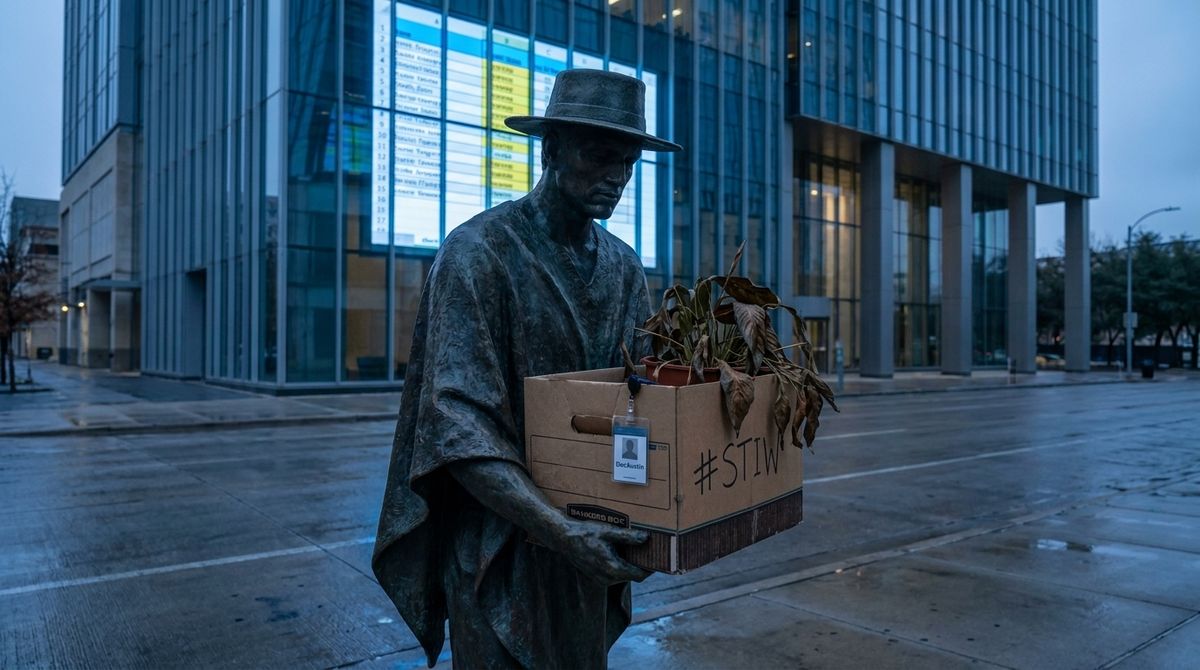
"You know what you did." That was the answer I was given when I asked why I was being let go. Just like the lady at the holiday party, I was escorted out of the building. A week later a box arrived at my home with my personal belongings and my now dead plant. I took it pretty hard, as I have always been a top performer and regularly promoted, so this was an entirely new experience for me. But the experience became fuel for me professionally and later academically.
An article from HR Digest popped up on my reading list this morning. It addresses layoffs and the role AI is increasingly playing in decision making and the disturbing lack of human review. And the same theme from my experience over three decades ago has appeared in an entirely new and pernicious way: incompetence wrapped in cowardice.
The study behind the article is out of ResumeTemplates.com, a thousand managers at companies with more than five hundred employees, and the numbers read like a confession nobody meant to sign. Fifty-nine percent have used AI to conduct layoffs. Fifty-eight percent lean on it to decide who gets cut. That part I can live with, because a tool that surfaces data is a tool, and I spent a career arguing for evidence over politics. But keep reading.
Forty percent let the AI make the call independently, with no human review. Seventeen percent do it often or constantly. One in three asked the model to weigh how often a person took sick leave. One in seven fed it the employee's age. Forty percent of these managers had no ethical training for any of it, and fifty-eight percent could not tell you whether the tool had ever been tested for bias. Read that last number twice. More than half are running human livelihoods through a machine they cannot certify is not discriminating, and they are letting it decide.
Now let me tell you what that actually is, because I have been on the receiving end of the human version. When my boss's boss fired me, she at least had to stand there and do it. She had to arrange her face into that smirk. She had to say the words, or rather refuse to say them, because "you know what you did" was her way of not owning a decision she knew could not survive daylight. That was cowardice. But it was cowardice with a face and a name, sitting in a chair across from me. There was a human in the loop, and that human was accountable, even as she spent every ounce of the accountability dodging it.
What the article describes is the same cowardice with the face sanded off. The smirk outsourced to a dashboard. "You know what you did" becomes "the model flagged you," and now not even the coward has to say it. The manager points at the algorithm. The vendor points at the manager. The algorithm cannot point at anything, and it certainly cannot look you in the eye. Two in five of the people in that survey have found a way to end a career without a single human being willing to put a name on the ending.
I have spent years on the empty chair, the seat that should hold the person who will live with a decision. A layoff is the most consequential thing most managers will ever do to another human being, and two in five have pulled a chair up to the table for the algorithm while leaving two chairs empty: the one for the person being cut, and the one for whoever is supposed to own the cut. When the machine flags a fifty-eight-year-old who took medical leave last spring, whose decision is that? I wrote about this exact vanishing act on the hiring side in Nobody's No. This is the same weather, except now it is somebody's mortgage, somebody's dignity, and the box of belongings that lands on their porch a week later with a dead plant inside.
And here is the part that should scare the lawyers. Age is a protected class. Disability is a protected class. Sick leave and medical absence are proxies for both. A third of these managers are feeding the machine the exact variables that federal law was written to keep out of the room, with no bias testing and no training, and then not reviewing what comes back. That is not efficiency. That is building a discrimination engine and unplugging the one thing that might catch it, which is a conscientious human who actually reads the list.
Here is what a smirking executive taught me thirty years ago that no dashboard ever will. A firing is a moral act. It deserves a human being willing to look another human being in the eye and own the reason, out loud, in daylight. "You know what you did" was a coward's sentence, but at least a coward had to say it.
So my question this morning, for every manager with that tool open in a tab. When the layoff list comes back, are you reviewing it, or are you just forwarding it?
Because a box is going to show up at somebody's door. Make sure you can tell them who packed it.
Source: Managers Are Using AI to Plan Layoffs, Some Without Any Human Supervision, The HR Digest

#AI #Layoffs #HR #Accountability #Leadership #EthicalDecisionMaking #TheEmptyChair #STIW